
Foot Surgery: Does a Sesamoidectomy Mean the End of My Running Career?

The best laid plans of mice and ultrarunners....
My surgery was supposed to be a rather routine operation on my right big toe, but things didn't go exactly as planned.
Let's back it up a bit and I'll explain how I got into this mess. I've been having pain in my right big toe for about 18 months now. Actually, probably longer, but my memory is a bit fuzzy. I just considered the pain a 'mild annoyance' that I just had to deal with until I was walking down a hallway one day in high heels and caught sight of my reflection in a glass window. I had no idea how much I was compensating for the pain - even just walking around - until then. Because of the pain in the big toe joint, I was walking on the outside portion of my foot and sort of rolling my leg around to avoid bending the toe... I started to think - if I was doing that walking, what the heck was I doing while running??
I went to a podiatrist in New York, who took x-rays and concluded that I had 'capsulitis', or inflammation of the big toe joint. No problem. He gave me an injection directly into the toe joint of a mixture of corticosteroid to reduce the inflammation and 'hyaluronic acid', which can best be described as 'lube' for your joints (boys, keep your minds outta the gutter). The shot worked like a dream. The pain went away and my toe joint could suddenly bend like normal. Score! I was back to strutting around the office in pink high heels in a matter of days. And oh yeah, with some red light therapy (one of the biggest red light therapy benefits is inflammation reduction), I could run normally again.
A couple months later I was back to square one. I went back to the podiatrist and asked about the risks of getting another corticosteroid shot. You see, the benefits were pretty clear to me. The injection goes right to the area of inflammation, which makes it more of a 'targeted' treatment than simply taking anti-inflammatory drugs orally (such as aspirin). The shot has a strong and powerful anti-inflammatory, and while it doesn't reduce pain directly, it usually does indirectly by reducing the swelling and inflamed area. Plus, you get to freak people out by telling them you're on 'roids (kidding).
Okay, so onto the negative side effects. Other than the usual possible side effects of any injection (eg. infection at the injection site), there is a reason not to take corticosteroid injections lightly. Tendons can be weakened by corticosteroids when the injection occurs near the tendons, and in rare cases can lead to rupture. FYI this is why corticosteroid injections are not used around the Achilles tendon!
Okay, well, I wasn't going to get an injection near a tendon - it was going to be localized in the big toe joint - so that wasn't going to be a big worry. The main thing I had to be concerned about was the long-term effects of repeated steroid injections. Multiple injections into a joint over time are not advisable, as this can cause thinning of the joint cartilage, weakening of the ligaments, and damage to the soft tissue... Most podiatrists will limit the number of injections to three or four, but I figured I was okay with two. The second shot worked brilliantly again and helped me get through my first 100 miler (leading to my first win of a 100 miler!)
Fast forward to March of this year when I was experiencing pretty significant pain (again) in that darn right big toe joint (fancy name: 1st metatarsophalangeal joint, or MTP joint). I went and found a very well-respected podiatrist in London, Dr. Simon Costain of the Gait and Posture Center, who has over 30 years of experience and has previously worked with the British Olympic team. I felt comfortable putting my feet in his hands (so to speak!) and discussed my options. We agreed that there was very little flexibility in the joint and given the fact that the Australia race was just a few weeks away, there wasn't much time for other conservative forms of treatment. Steroid injection number 3 it was...
Unfortunately, this injection didn't have any effect on my pain. This is actually quite common - the more injections you get, the less effective they become. Darn it! I was running out of options.
I went to see Steve Bessant, neuromuscular guru who is CHEK certified, and he found that the tendons that were connected to the big toe were much tighter on the right than on the left. Perhaps that was contributing to the inflexibility of the toe and the pain! For those anatomy buffs out there (if there is such a thing), there are two tendons associated with that big toe joint: the flexor hallucis longus ("A" in the diagram to the right), which brings the big toe down/flexes the foot down, and the flexor hallucis brevis ("B" in the diagram to the right), which brings the big toe down.
The manual work that Steve did helped improve the flexibility of my toe somewhat, but darn it, the pain just wasn't going away. So finally, the week before I left for Australia, I went back to Dr. Costain to pull out the big guns. He said there was one more injection I could try - it was a stronger corticosteroid, and while it wasn't ideal to rely on drugs as a long-term solution, we thought it might help get me through the race.
As you all know, I did make it through the race... but it wasn't without pain. I guess I just figured it was the usual form of pain associated with ultrarunning. Hmm. I probably just forgot what normal felt like because the pain had been there for so long, increasing over time. Looking back on it, I realize that I had started to avoid walking even just a couple of blocks during the day if I could. I could block out the pain when I was in training, but there wasn't anything I could do to distract myself during my normal day-to-day activities. I suppose that should have been a warning sign....
When I got back to London, I went in for x-rays on my foot to see what was really going on. Much to our (pleasant) surprise, the joint space in the big toe was much better than we thought, but we thought we should get an opinion from Dr. Lowell Scott Weil Sr., an expert foot and ankle surgeon based in Chicago, to see what my surgical options were.
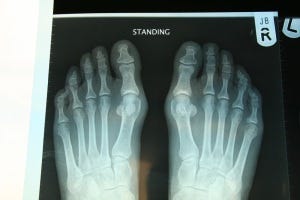
Dr. Weil saw that there was some deformity in my right big toe. If you look closely at my x-ray above, you can see that the right big toe angles in toward my other toes more so than the left big toe (fancy name: hallux valgus). Dr. Weil said it didn't look TOO bad, but it sounded like I had tried all other methods (orthotics, manual therapy, injections) and surgery would help.
Off I flew to Chicago for a simple 'scarf bunionectomy', which involved cutting the bone of the first metatarsal and repositioning it with titanium screws so that it is more in line. If you want to see an animated video of what that entails, click the link! (Oh fun - what a glamorous life I lead, eh?) I was seriously worried about going under the knife, but Dr. Weil came so highly recommended that I knew I was seeing the best. I would make a full recovery and get back to running in a number of weeks.
I was in good spirits while waiting to be wheeled into the operating room. I tried to ignore the sounds of the saw cutting through the bones of the patients before me (EEEK!) and concentrate on my suduko puzzle in front of me. The staff at Dr. Weil's clinic were AWESOME - very down to earth, funny, and willing to answer all of my inane questions. I joked with Dr. Weil as the anesthesiologist put me under... and apparently I kept chatting away throughout the whole surgery about running with horses in Vermont and also about this blog! Hmm, I wonder what else I said????
When I woke up, I asked Dr. Weil how it went, and immediately got the sense that something went wrong. I saw him putting a piece of the bone that he had sawed out of my foot into a little container, which was to be sent off to pathology. The next few minutes were a little fuzzy, but I can distinctly remember asking a number of times if I could run again. "But I'll be okay to run ultras again, right?" It wasn't a good feeling, I'll tell you that. I tried to stay calm and remain focused so that I could ask Dr. Weil all of the questions that were floating through my head, but all I really wanted to do was hide under the covers and sob.
Dr. Weil explained that when he went into the foot, he checked the underside of the big toe (the first metatarsal) and got a bit of a surprise. He found a "complete tear of the medial head of the flexor hallucis brevis tendon" and one of the other tendons was almost completely disintegrated. "Mushy" was the word he used to describe it. He also found that there were signs of 'osteonecrosis' of the tibial sesamoid bone. which basically means that the bone was dying from a loss or diminished supply of blood. The sesamoid bone was virtually devoid of cartilage and it had been grinding away against the 'first metatarsal head' (the big toe joint), which could be seen in an area measuring about 1cm x .5cm. Apparently not unusual for people with bunions, but unusual for someone at the ripe old age of 27!!
Dr. Weil had no choice but to remove my tibial sesamoid bone, clean out the bone chips and reattach the flexor hallucis brevis tendon with a suture...
All I could think was WHAT DOES THIS MEAN FOR MY RUNNING?? (Doctor, will I be able to play the piano again?). Dr. Weil said with a strong rehab program, he hoped that I would be able to run marathons again, and if I could run marathons, I could run ultramarathons. I asked him if I would be fast, and he said that was up to me. Fair enough! I told him if I could run again, I could win again!
I've been doing a bit of research to figure out the implications of having a sesamoid bone removed. I had never heard of things strange little bones before - how important could they really be??? Turns out, a lot. If you look at the xray below, you may see two pea-shaped bones under each first toe. They look like little floating balls. These are the sesamoids - the inner one is the medial/tibial and the outer one is the lateral/fibular. They are located under the head of the first metatarsal (remember, the big toe joint) and in the tendons of the flexor hallucis brevis muscle.
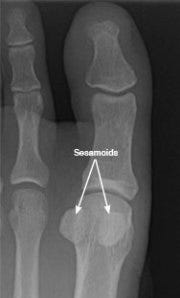
So what do our friends, the sesamoids, do? Two things:
(1) They absorb impact forces in the foot and help with stability.
(2) They help the big toe move normally and provide leverage when the big toe "pushes off" during walking and running.
Logic says that removing one of these important sesasmoid bones would make the rest of my foot weaker/more susceptible to injury and also cause me to lose stability and push off strength. Hmm.
OR, I could think of it this way: those extra tendons, bones, and floating bone chips were just extra weight that were dragging me down. Now that I got them out of the way, I'll be even faster in my next race. Um, yeah?
Well, anatomy lesson is over for now. I don't know about you, but this has exhausted me. Only time will tell. In the meantime, I am mastering the art of hobbling around in my surgical boot, which is rather amusing given that it is about 4 inches higher than any shoe I could possibly wear on my other foot. If I actually want to walk around balanced, I would probably have to invest in a pair of serious stilettos to wear on the left foot. Between looking like a crippled hooker and a female pirate, I choose pirate. ARRRRRR!
My foot has turned brilliant colours of black, purple and green and I still don't have all the feeling back in my toes... but I'm making progress. Think good thoughts!!! I'd love it if you'd comment on my blog sometime - I had no idea that people were actually reading this thing (I mean, other than my sister and my mom) until the Australia race. Thanks for all of your support!!